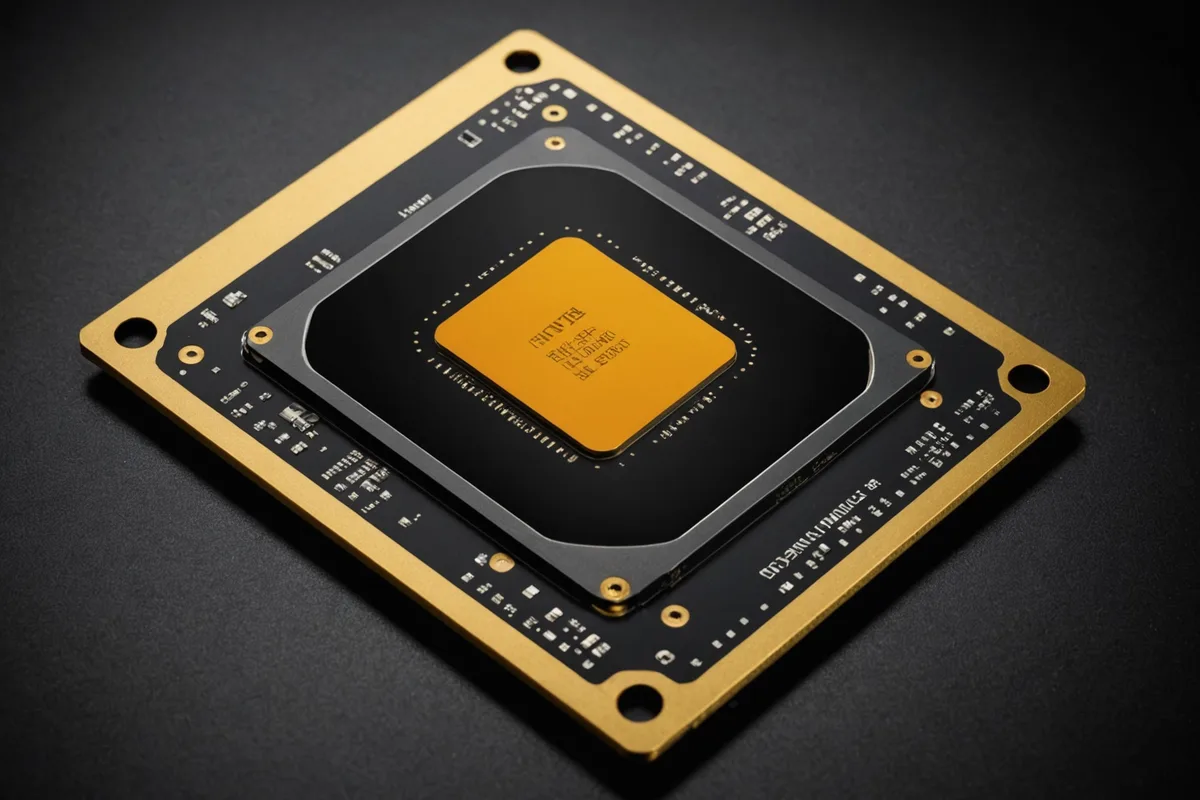
GSK-1 photonic inference co-processor
A PCIe 4.0 x16 card housing a 512-element MZI waveguide mesh on a 300 mm silicon photonic die. The GSK-1 attaches to an existing GPU inference node and offloads the matrix-multiply steps in transformer attention and feedforward layers, reducing per-token energy cost without requiring model recompilation.
GSK-1 hardware specifications
Evaluation kit hardware is available to qualified data-center inference teams. Production specification is subject to final tape-out; pre-production numbers are from wafer-level test of first-silicon samples.
| Die process | 300 mm silicon photonic (SiPh) platform, 220 nm Si waveguide layer |
| Matrix dimensions | 512 x 512 (native); tiling for larger layers is software-transparent |
| Precision | Effective 8-bit (optical SNR-bounded); INT8 host interface |
| Throughput (peak) | 1.2 TOPS at 8-bit equivalent precision |
| Power (thermal design) | 28 W TDP (optical + driver + ADC combined) |
| Energy efficiency | 2.4 TOPS/W in matrix-multiply path; 43 fJ/MAC (optical domain) |
| Host interface | PCIe 4.0 x16, 32 GB/s bidirectional; DMA for matrix and activation transfer |
| Form factor | Full-height, half-length PCIe card; standard 75 W slot + 1 x 8-pin power |
| Thermal | Passive heatsink standard; active cooling bracket optional; operating 0-55 C ambient |
| Weight bank memory | 8 MB on-die weight SRAM; persistent phase calibration stored in non-volatile register file |
| Modulator bandwidth | 1 GHz electro-optic modulator bandwidth; carrier-injection ring-resonator design |
| Laser source | On-board 1550 nm external-cavity diode; fiber-coupled, temperature-stabilized to within 0.01 nm |
| SDK | Python + C++ library; CUDA intercept layer; PyTorch and ONNX Runtime backends |
From PCIe slot to first inference in four steps
The GSK-1 is designed to drop into an existing GPU inference node without changing model files, CUDA code, or inference framework configuration. The SDK intercepts the matrix-multiply operations in a running PyTorch or ONNX session and routes them through the photonic co-processor transparently.
Seat the GSK-1 in a PCIe 4.0 x16 slot on any modern server board. No CPU PCIe lane reservation needed; the card uses an M.2 auxiliary clock for timing. Install the kernel module with pip install gsk-sdk[kernel] then run gsk-install-driver.
Run the on-board calibration sequence once after card insertion to null manufacturing phase offsets in the waveguide mesh. Calibration writes persistent phase correction values to the register file on the card and takes approximately 90 seconds.
Set the environment variable GSK_ENABLE=1 before starting your inference process. The intercept layer identifies torch.nn.Linear and equivalent ONNX Gemm nodes, quantizes weight matrices to INT8, and dispatches them to the GSK-1 via DMA.
Start your existing inference script. No model changes, no framework patches. The SDK logs energy-per-token metrics to gsk.log for comparison against your GPU baseline. To verify offloading is active, call gsk.status() from Python.
import gsk
import torch

# One-line device check after driver install
gsk.init()
print(gsk.status())  # GSK-1 ready, mesh calibrated, 28W TDP

# Load existing model unchanged
model = torch.load("weights/llama-7b-q8.pt")
model.eval()

# Wrap once: all nn.Linear layers are offloaded
model = gsk.wrap(model)

# Run inference as normal
with torch.no_grad():
    output = model(input_ids)

# Read energy report
report = gsk.energy_report()
print(report["joules_per_token"])Where the GSK-1 delivers the highest return
The photonic co-processor is most cost-effective in workloads where inference is continuous, model weights are stable between requests, and energy is the binding constraint per query.
Auto-regressive token generation re-runs transformer attention and feedforward layers for every token. The weight matrices are static across the entire generation run. The GSK-1 loads weights once and performs repeated multiply-accumulate operations against changing activation vectors, which is precisely the access pattern the photonic mesh is optimized for.
Semantic search, retrieval-augmented generation indexing, and recommendation systems generate embeddings in high-throughput batch mode. These workloads run the same encoder architecture repeatedly. The GSK-1 keeps encoder weights programmed in the mesh and processes activation batches through without weight reload overhead.
Inference fleets that serve several models in rotation can co-locate the GSK-1 with the GPU to handle the largest matrix layers while the GPU manages attention masks, sampling, and KV cache. The PCIe interface supports concurrent access from multiple GPU processes, so multiple model contexts can share the co-processor time-multiplexed.
Operators running under power purchase agreements with carbon intensity constraints benefit from reduced joules-per-inference-token. The GSK-1 can be justified purely on energy savings relative to GPU-only configurations, with payback periods that depend on local electricity cost and inference utilization rate.
Evaluation kits available for qualified teams
The GSK-1 evaluation kit includes one PCIe card, the calibration fixture, SDK documentation, and a 60-day assisted evaluation period with application engineering support from the Great Sky team in Boulder.